
Find Massachusetts Death Records Online
The Massachusetts Death Index spans records from 1841 to the present across all 14 counties in the state. The Registry of Vital Records and Statistics holds certified death records from 1926 forward. The Massachusetts State Archives covers 1841 through 1925 and offers free digital access to records through 1924. Whether you need a certified death certificate for legal purposes or are searching the Death Index for genealogical research, this guide covers where to look, what records contain, what they cost, and how to request copies from the offices that manage Massachusetts death records.
Massachusetts Death Index at a Glance
Where Massachusetts Death Records Are Kept
Two state agencies hold the bulk of Massachusetts death records. The Registry of Vital Records and Statistics handles records from 1926 to the present. The office is at 150 Mount Vernon Street, 1st Floor, Dorchester, MA 02125. Phone: 617-740-2600. Email: vital.recordsrequest@mass.gov. Office hours run Monday through Friday, 8:45 a.m. to 4:45 p.m. Genealogical research has more limited windows: Monday and Thursday from 1 to 4 p.m., and Tuesday and Friday from 9 a.m. to noon. The RVRS issues certified copies of death certificates bearing the official state seal. These copies meet legal and insurance requirements.
The Massachusetts State Archives holds death records from 1841 through 1925. Find it at 220 Morrissey Boulevard in Boston. Phone: 617-727-2816. Email: archives@sec.state.ma.us. One standout feature is free digital access. The Archives has made images of Massachusetts death records from 1841 through 1924 available to view online without charge. This lets you confirm a record exists before ordering a paid copy. Staff also provide free email research assistance for up to five unique records from the 1841 to 1930 collection. Certified copies cost $3.00 each. Processing takes 4 to 6 weeks, with a limit of five per order. Mail requests to Massachusetts Archives, Attn: Certified Vitals, 220 Morrissey Blvd., Boston, MA 02125. Checks payable to Commonwealth of Massachusetts.
The Registry of Vital Records and Statistics at mass.gov lists all request methods, fees, and required identification for obtaining Massachusetts death certificates from the state office.
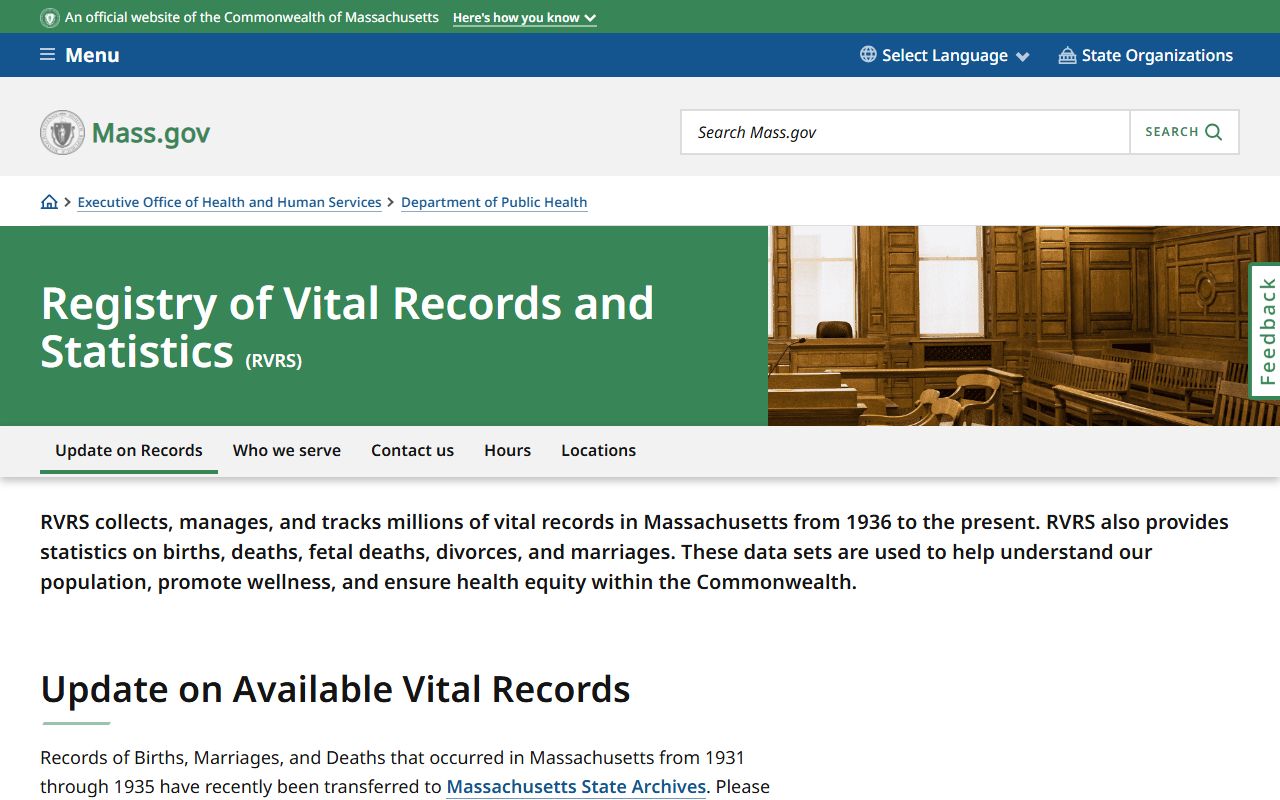
That page also explains what information you need before making a request: the deceased's full name, date of death, place of death, and a valid government-issued photo ID. In some situations, documentation of your relationship to the deceased is also required.
City and town clerks form the third layer of access. Massachusetts has 351 cities and towns. Each one keeps death records for deaths that occurred or were registered in its jurisdiction under General Laws Chapter 46, Section 2. For deaths from 1926 forward, records typically exist at both the local clerk and the RVRS. The local clerk is often faster for in-person visits. Records before 1841 exist only in town archives and are not part of any statewide index.
How to Search the Massachusetts Death Index
The RVRS does not offer a free public name search online. You must submit a paid request to look up a record through the state office. Before committing to an order, several databases let you search at no cost or low cost. FamilySearch at familysearch.org is free and carries multiple Massachusetts death record sets: Massachusetts Deaths 1841-1915 and 1921-1924 (indexed with images), Massachusetts Town Deaths Index covering roughly 1640 to 1961, Massachusetts Town Clerk Vital and Town Records 1626-2001, and the Massachusetts Death Index 1970-2003. Search by name, date, or town. Most searches do not require a FamilySearch account. Coverage spans all 14 Massachusetts counties and draws from both the statewide index and individual town records.
The Massachusetts State Archives vital records collection provides online access to digitized death records from 1841 through 1924. You can browse by year and town at no charge. This is a strong first step for research in the 19th and early 20th century.
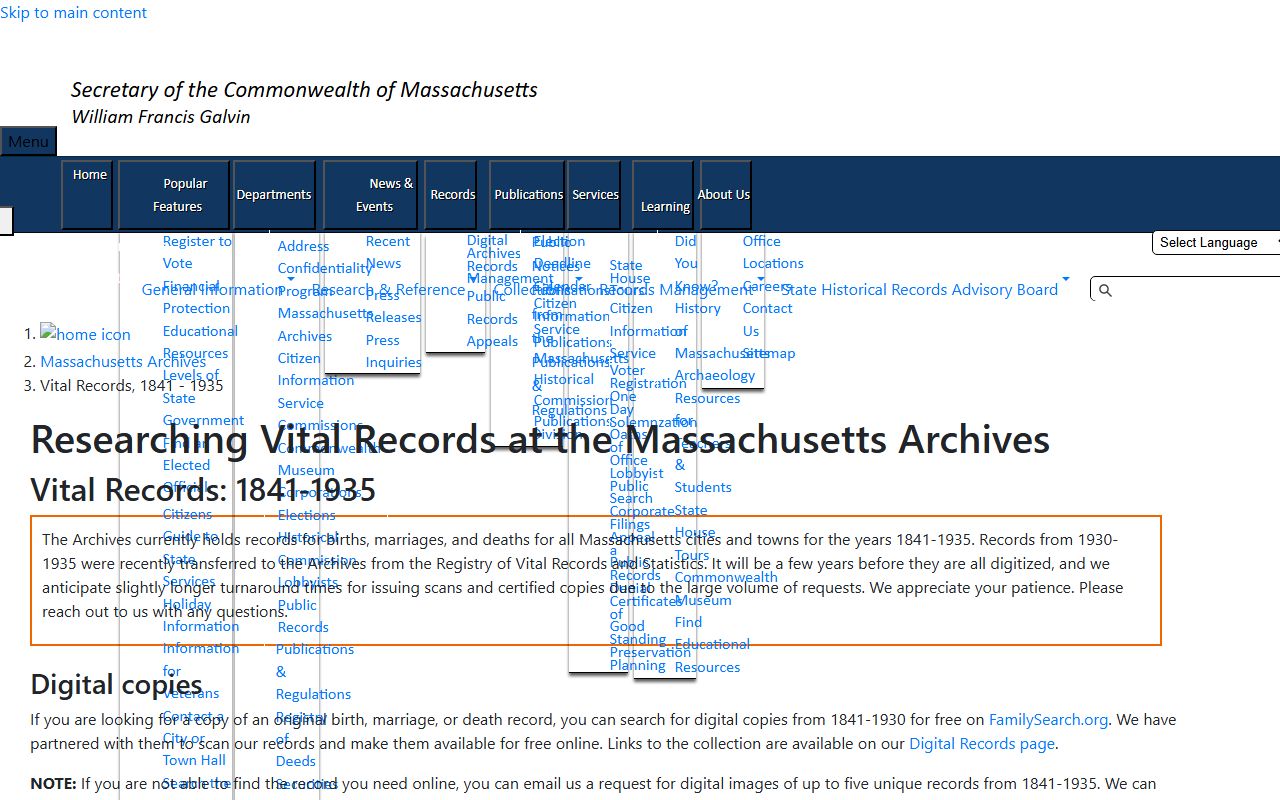
Digitized images on the Archives site cover original handwritten death registers and are useful even when the indexing is incomplete. Staff can help with entries that are difficult to read.
Ancestry.com holds the Massachusetts Death Index from 1901 through 1980 and a continuation from 1970 to 2003. A paid subscription is required. AmericanAncestors.org, run by the New England Historic Genealogical Society, has high-quality scans of Massachusetts vital records from 1841 through 1920. MyHeritage carries the Massachusetts Death Index from 1840 to 1910. Fold3 covers the Massachusetts Vital Records Index from 1841 to 1895. Findmypast has Massachusetts Deaths from 1969 to 2010. The Social Security Death Index on FamilySearch adds coverage from 1935 to 2014. Each platform draws from different sources, so checking more than one improves your chances of finding the record you need.
Fees for Massachusetts Death Certificates
Costs vary by how you order. In person at the RVRS in Dorchester is the cheapest at $20 per copy. Payment is by check or money order only. No credit cards at the counter. Genealogical research hours at the RVRS are limited, so plan your visit around those windows if you need staff assistance with older records.
Mail orders from the RVRS cost $32 per copy. Standard processing takes about 30 business days. Expedited service is available and takes 7 to 10 business days. Send your request with the deceased's full name, date of death, place of death, and your contact details to the Registry of Vital Records and Statistics, 150 Mount Vernon St., 1st Floor, Dorchester, MA 02125. Make checks payable to the Commonwealth of Massachusetts.
The ordering guide at mass.gov covers all three request methods in detail, including what identification is required for each one.
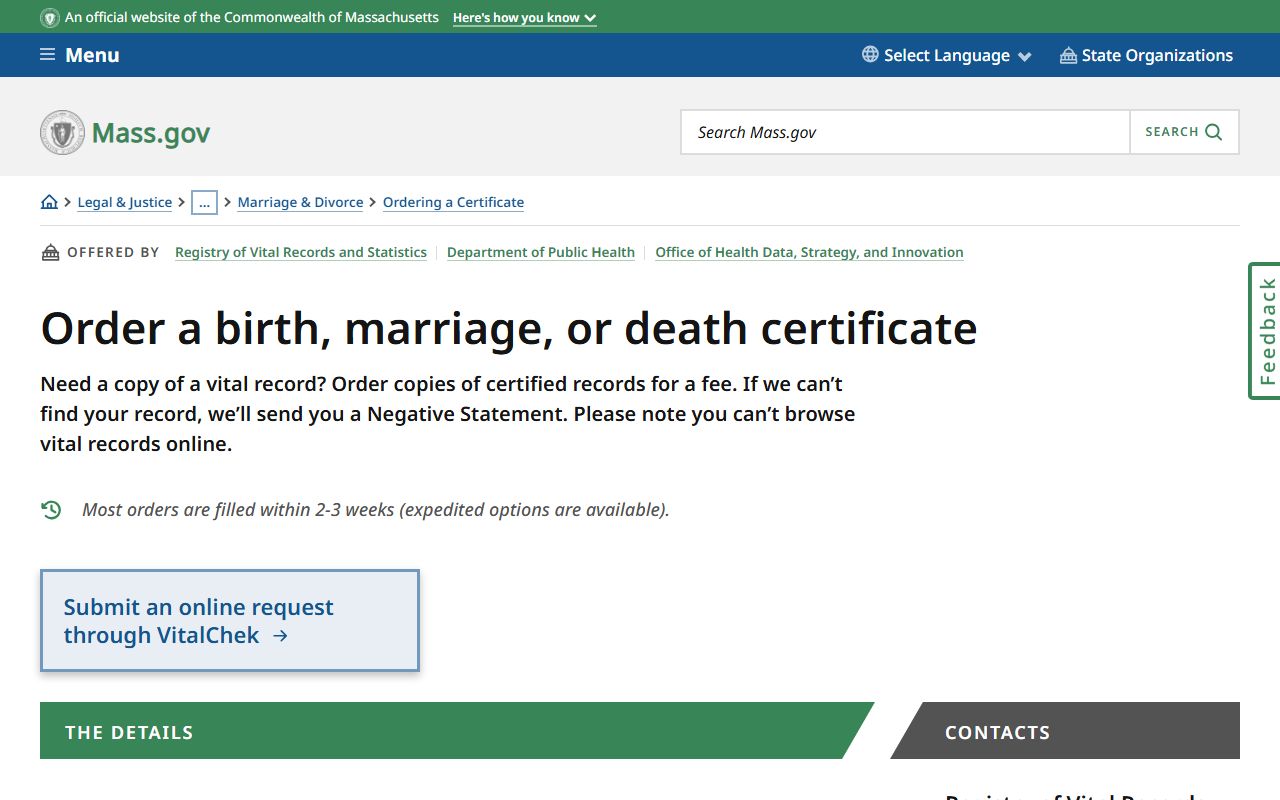
Online orders go through VitalChek at vitalchek.com or by calling (866) 300-8535. The first copy costs $54 and each additional copy costs $42. Standard delivery takes 7 to 10 business days. Expedited next-day service is available for an extra charge. State Archives certified copies cost $3.00 each with a 4 to 6 week wait. Massachusetts General Laws Chapter 46, Section 26 authorizes fees for vital record copies. Chapter 66, Section 10D states that the first two hours of any public records search are free.
Note: City and town clerk fees vary across Massachusetts and may differ from RVRS rates. Contact the clerk in the city or town where the death occurred to confirm current costs before sending payment.
What Massachusetts Death Certificates Contain
A Massachusetts death certificate is a detailed legal document with seven sections. The funeral director fills in most personal information. The attending physician or medical examiner certifies the cause of death. The informant provides family data. The local clerk completes registration. Every death in Massachusetts receives a unique state file number that places it in the Death Index. Under General Laws Chapter 46, Section 1, the contents of death certificates are defined by state law, ensuring a uniform format across all 351 cities and towns.
The personal information section covers the deceased's full name and maiden name if applicable, date and place of birth, Social Security number, sex, marital status, and spouse's name. Usual occupation, the kind of business or industry, and whether the person served in the U.S. Armed Forces are also captured. The home address including county and whether it falls inside city limits completes this section. The death information section records the place of death (facility name and full address), the type of facility, and the method of disposition: burial, cremation, entombment, removal from state, donation, or other. Funeral home name, license number, and funeral director signature are part of this section too. Together these first two sections document where and how a person lived and what happened after they died, making Massachusetts death records a rich resource for both legal and genealogical work.
The cause of death section is completed by the physician or medical examiner. It records the immediate cause of death, the sequence of underlying causes, and any other conditions that contributed but were not the direct cause. Manner of death is marked as natural, accident, homicide, suicide, pending investigation, or could not be determined. If an injury was involved, the form captures the date, time, place, and description of how it happened. Autopsy results are noted if applicable. This section is often required for insurance claims and estate proceedings.
Parent information names the deceased's father (full name and birthplace) and mother (maiden name and birthplace). The informant section records who provided the data and their relationship to the deceased. The certifier section names the physician or medical examiner who signed the record. The local registration section shows when the city or town clerk received the filing and assigns the state file number that enters the death into the Massachusetts Death Index.
Massachusetts Death Index Laws and Access
Death certificates are public records in Massachusetts. Any person can request a certified copy. This right comes from General Laws Chapter 46, which governs vital records statewide. Section 9 of Chapter 46 requires death certificates to be filed within 24 hours of death. The attending physician or medical examiner must sign the record before burial or cremation can proceed. Section 9 also covers the state electronic registration system that funeral directors and physicians use to file records without paper forms.
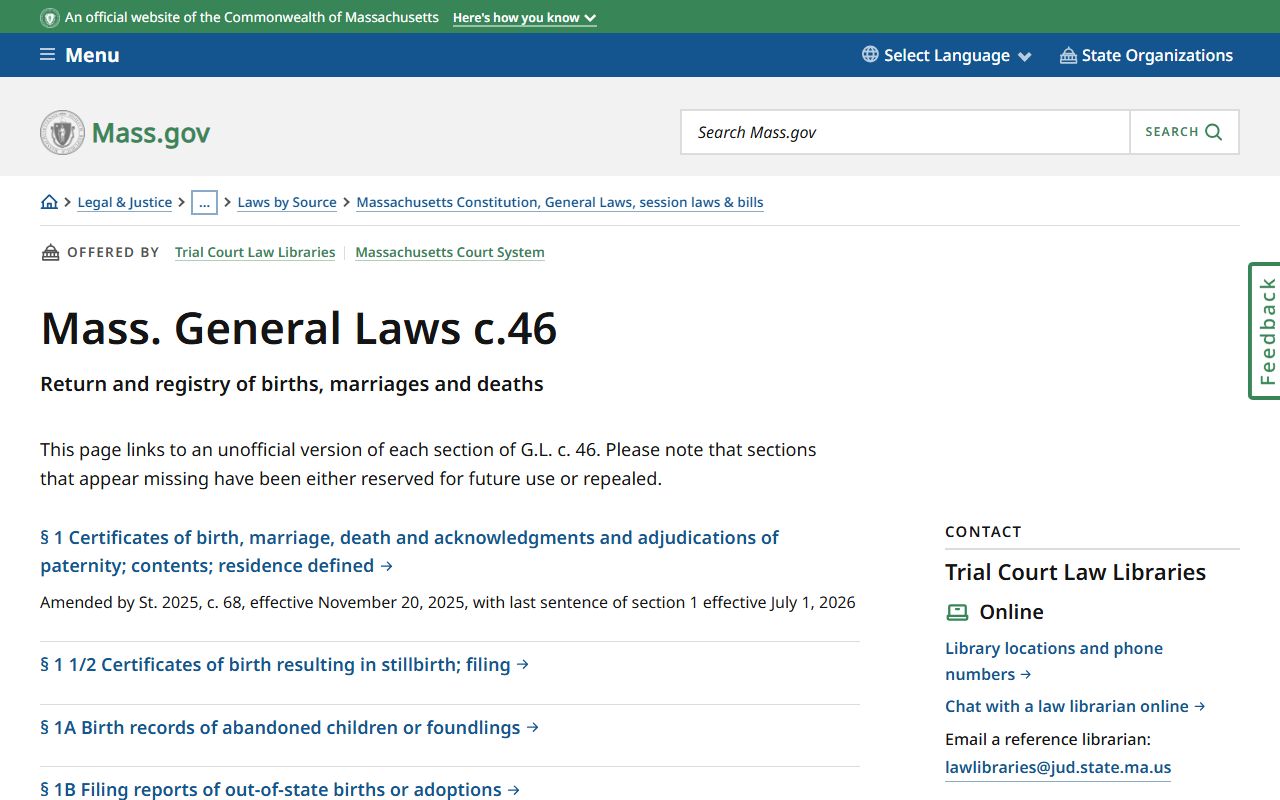
Chapter 46, Section 12 authorizes city and town clerks to issue certified copies bearing a raised seal. A copy without the official seal is not valid for legal purposes. Section 2A sets conditions for disclosure. Most death records are fully open. Where a record has a statutory restriction, the requesting party will be notified and may need to provide additional documentation. Section 13 governs amendments. To correct an error in a Massachusetts death record, you must contact the city or town where the original record was filed, provide documentation of the error, and pay an amendment fee that is typically around $50. Turnaround runs from one week to one month. Under Section 19, certified copies are admissible as evidence in court proceedings.
General Laws Chapter 38 establishes the Office of the Chief Medical Examiner. Medical examiner investigations are required for deaths by violence, suicides, deaths in custody, and deaths with unknown or suspicious causes. Chapter 38 also governs how those death certificates are created and filed. Massachusetts General Laws Chapter 66, Section 10, defines public records access rights and applies to death record requests at city, town, and state offices.
Historical Records in the Massachusetts Death Index
Massachusetts launched the first statewide death registration system in the country in 1841. Before that year, death records existed only at the town level. Some records go back to the 1600s, but coverage is uneven. Boston was excluded from the statewide index until 1850. For a Boston death between 1841 and 1849, contact the Boston Registry Division directly or search through the State Archives.
The "Tan Books" are an essential resource for pre-1900 Massachusetts deaths. These published volumes take their name from their tan-colored covers. The New England Historic Genealogical Society produced most of them. About 236 Massachusetts towns have Tan Book coverage. Each volume arranges vital records alphabetically within birth, marriage, and death categories. Church and private records are often included alongside official town entries. These books are digitized and free to access on FamilySearch, Google Books, and the Internet Archive. Because records were rearranged alphabetically from their original chronological order, always verify Tan Book entries against the original records when possible.
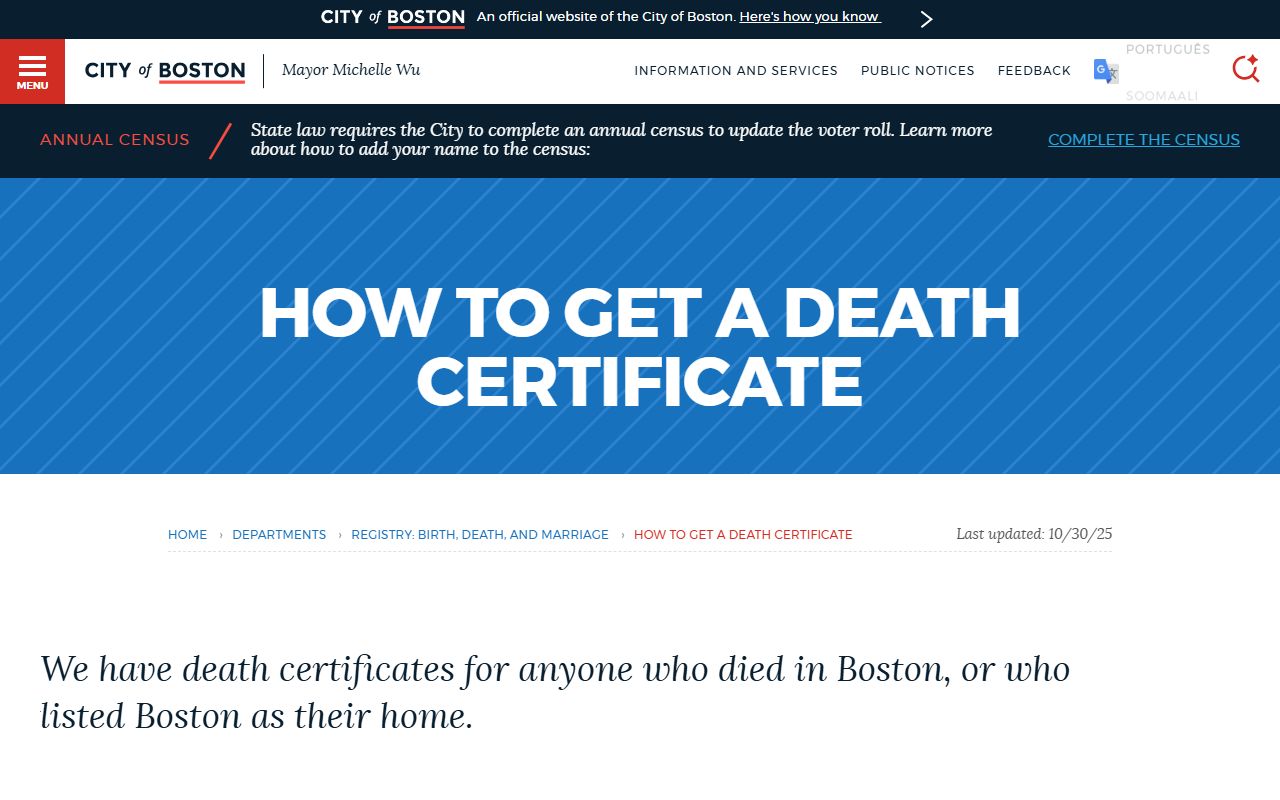
The Boston Registry Division holds death records going back to 1630, one of the oldest continuous death record sets in the country. Death certificates from 1956 to the present are available in person at 1 City Hall Square, Room 213, Boston. Pre-1956 records must be ordered by mail. The Registry also offers free translation services in more than a dozen languages.
The Massachusetts State Archives digitized original death records from 1841 through 1924. These images are browsable online by year and town at no charge. Records from 1931 through 1935 were recently transferred from the RVRS to the Archives, so those years now exist at both agencies. For deaths after 1925, the RVRS is the primary source. These overlapping periods mean a single death may appear in more than one place, which can help with cross-referencing details.
Massachusetts Death Index by County
Each of the 14 Massachusetts counties has its own Probate Court and Registry of Deeds. Death records are filed with city and town clerks and sent to the state. Pick a county below to find local office details, resources, and city links for death record research in that area.
View All 14 Massachusetts Counties
Death Index Records by Massachusetts City
Major cities in Massachusetts each have a city or town clerk that holds local death records. Each city page below covers local clerk contact details, fees, request procedures, and historical record availability.